

販売情報提供活動ガイドライン
確認・追記:2026年10月11日
今回の確認対象:2024年2月21日Q&A(その4)による補足、研究倫理指針の版と適用時期、治験・臨床研究情報の参照先。ガイドラインは2018年9月25日通知に基づくものであり、原資料とその後の補足資料を分けて掲載しています。
本節の社内体制・記録・苦情窓口に関する補足は,2019年2月20日Q&A(その1)のQ21(MA部門),Q25(審査者と委員会),Q31〜32(業務記録),Q33〜34(苦情窓口)を参照している。ガイドライン本体の記載と区別して確認されたい。
販売情報提供活動ガイドラインの概要
現代における製薬企業の活動は複雑化・多様化しており,いわゆるメディカル・サイエンス・リエゾン(MSL)が行う医学情報の提供や,企業広報として行うメディアセミナー,投資家向けプレスリリース,患者向けの疾患啓発など,薬機法上の広告該当性の3要件を満たすかの判断が難しい事例が増えていると言われている。そのような背景もあり,「広告」よりも広義である「販売情報提供活動」を規制対象とする「販売情報提供活動ガイドライン」は2019年4月1日から適用された。ただし,第2及び販売情報提供活動監督部門に関連する事項は,同年10月1日から適用された(第4の8)。1.適用主体
当ガイドラインの適用主体は,医薬品製造販売業者とその販売情報提供活動の委託先・提携先(いわゆるコ・プロモーションの相手先企業を含む)及び医薬品卸売販売業者である(以上を総称して「医薬品製造販売業者等」という。)。 また,医薬品製造販売業者等において適用対象となるのは,医薬品製造販売業者等が雇用する全ての者であり,医薬情報担当者(GVP省令第2条5項に規定する者。MR),メディカル・サイエンス・リエゾン(MSL)その他の名称や所属部門にかかわらない。なお,メディカルアフェアーズ部門やMSLの活動について,「販売情報提供活動」とは明確に切り離すことを自社の規則で規定している場合であっても,「販売情報提供活動」の該当性は,実際になされた活動により個別に評価・判断されるものであり,社内規則を規定していることをもって自動的に当ガイドラインの適用から除外されるわけではない。 また,医薬品製造販売業者等が主催するイベントにおける外部専門家(医療関係者など)による講演であっても,イベント等の趣旨及び目的から「販売情報提供活動」の要件を満たす場合は,当ガイドラインの対象となる。2.適用行為
当ガイドラインにおいて「販売情報提供活動」とは,「能動的・受動的を問わず,医薬品製造販売業者等が,特定の医療用医薬品の名称又は有効性・安全性の認知の向上等による販売促進を期待して,当該医療用医薬品に関する情報を提供することをいい,医療用医薬品の効能・効果に係る疾患を啓発(一般人を対象とするものを含む。)することも含まれる」と定義されている。当ガイドラインは,明確な虚偽誇大とまではいえないものの不適正使用や誤使用を助長すると考えられる行為など,広告該当性を判断することが難しい広告又は広告類似行為も対象に,現状を改善するために策定したものであるため,「その販売促進を期待して」とは,広告該当性の三要件にある顧客誘引性(「顧客の購入意欲を昂進させる意図が明確であること」)よりも広義であることに注意する必要がある。また,適正広告基準に従って行う疾患啓発活動であっても,当ガイドラインの適用範囲となる。3.販売情報提供活動の原則と禁止事項
当ガイドラインは,以下の4つを販売情報提供活動の原則として掲げている。- 提供する医療用医薬品の効能・効果,用法・用量等の情報は,承認された範囲内のものであること。
- 医療用医薬品の有効性のみではなく,副作用を含む安全性等の必要な情報についても提供し,提供する情報を恣意的に選択しないこと。
- 提供する情報は,科学的及び客観的な根拠に基づくものであり,その根拠を示すことができる正確な内容のものであること。その科学的根拠は,元データを含め,第三者による客観的評価及び検証が可能なもの,又は第三者による適正性の審査(論文の査読等)を経たもの(承認審査に用いられた評価資料や審査報告書を含む。)であること。
- 販売情報提供活動の資材等に引用される情報は,その引用元が明記されたものであること。また,社外の調査研究について,その調査研究の実施や論文等の作成に関して医薬品製造販売業者等による物品,金銭,労務等の提供があった場合には,その具体的内容も明記されたものであること。なお,社外の調査研究については,「臨床研究法」(平成29 年法律第16 号),「人を対象とする医学系研究に関する倫理指針」(平成26 年文部科学省・厚生労働省告示第3号)その他これらに準ずる指針等を遵守したもののみを使用すること。
研究倫理指針の参照先に関する補足
前掲の「人を対象とする医学系研究に関する倫理指針」は,2018年のガイドライン通知に記載された当時の指針名である。2021年にはゲノム指針と統合され,「人を対象とする生命科学・医学系研究に関する倫理指針」が制定された。2026年10月11日時点での参照先は,2023年3月27日一部改正版及び関連ガイダンスであり,各研究に適用される経過措置も確認する必要がある。
2026年8月27日一部改正版も公表されているが,適用開始は2026年12月1日である。現在適用される2023年改正版/2026年改正の施行通知/指針・関連ガイダンス一覧
加えて,以下の7つを「禁止行為」として掲げている。- 虚偽若しくは誇大な表現又は誤認を誘発させるような表現の使用その他広告規制において禁じられている行為をすること。
- 承認された効能・効果,用法・用量等以外の使用方法を推奨すること。なお,外国において承認等を得ている場合であっても同様であること。
- 科学的又は客観的な根拠なく恣意的に,特定の医療用医薬品の処方,使用等に誘引すること。
- 他社製品を誹謗,中傷すること等により,自社製品を優れたものと訴えること。
- 疾患の罹患や疾病の症状を過度に強調し,不安を煽ること。
- 一般人向けの疾患啓発において,医療用医薬品による治療(診断及び予防を含む。以下同じ。)のみを推奨するなど,医療用医薬品による治療以外に治療の手段がないかのように誤認させること。
- その他医療用医薬品の不適正使用又は誤使用を誘発させるおそれのある表現を行うこと。
Q&A(その4)による補足(2024年2月21日)
厚生労働省の追加Q&Aでは,次の取扱いが明確化されている。
- 他社製品・比較情報:医師又は薬剤師の求めに応じる場合は,具体的な要求を確認し,内容・提供先を要求に沿って限定すること,科学的・客観的根拠に基づく正確な情報を提供すること,直接比較が科学的に適切でない場合は理由等を説明することが必要である。他社に不利な情報だけを恣意的に選ぶことや,求めがあったと装うことは認められない。なお,求めがない場合に比較情報の提供を一律に禁止する趣旨ではなく,広告該当性に関する通知や適正広告基準の解説等を踏まえて適切に行う必要がある(Q1・Q10)。
- 有効性・安全性の比較:患者背景等が異なる試験成績の単純比較が科学的に公平とはいえない場合がある。出典と主要・副次評価項目の位置付けを明示し,安全性については特定の副作用だけでなく全体像を示す必要がある(Q3・Q6)。
- 未論文化の学会発表:医師又は薬剤師の求めに応じる比較情報等では,未論文化であることのみをもって提供不可とはならない。ただし,未論文化の学会発表であり,エビデンスが十分に確立されているとはいえないことを明確に説明するなど,ガイドライン及び適正広告基準を遵守する必要がある(Q4・Q8・Q12)。
- 適応外情報へのその場の回答:適切に回答する準備が整っている場合,医師又は薬剤師の求めにその場で回答すること自体は禁じられていない。提供先を要求者に限定するなど,ガイドライン第4の3の条件に従う必要がある(Q11)。
厚生労働省:Q&A(その4)原文/2018年ガイドライン原文
経営陣の責務
4.経営陣の責務
当ガイドラインにおいて,医薬品製造販売業者等の経営陣は,自社のあらゆる従業員の販売情報提供活動に関する業務上の行動に対して責任を負うものであることが明記され,適切な販売情報提供活動を実施するため,必要な社内体制の整備等につきリーダーシップを取ることが求められている。その主な内容は,以下の通りである。- 販売情報提供活動の資材等や販売情報提供活動自体の適切性等をモニタリングする部門(販売情報提供活動監督部門)を販売情報提供活動の担当部門から独立した形で社内に設け,その責任者を明確化するとともに,販売情報提供活動の担当部門・担当者に対して必要なモニタリング等の監督指導を行うことができる権限を付与すること。
- 自社からの独立性を有する者が含まれる審査・監督委員会を設け,販売情報提供活動監督部門における活動について,その責任者に対して必要な助言を行わせること。
- 販売情報提供活動監督部門は経営陣に対して販売情報提供活動の実施状況を報告するとともに,必要がある場合には,審査・監督委員会の助言を踏まえて経営陣に意見具申をすること。経営陣は当該意見を踏まえて適切な措置を講じること。
- 役員・従業員が適切な情報提供活動を行ったかどうか及び行わせたかどうかを確認し,役員・従業員に対する評価に適切に反映すること。また,適切な販売情報提供活動を実施できるよう,役員・従業員に対し定期的に教育を実施すること。
- 販売情報提供活動の担当部門・担当者に,販売情報提供活動に係る業務を適切に行うために必要な手順書を作成させるとともに,業務記録(販売情報提供活動において口頭で説明等を行った内容の記録を含む。)を作成させ,当該業務記録を適切に保管させること。また,厚生労働省,関係自治体やPMDA から販売情報提供活動に関係する資料の提出を求められた場合には,販売情報提供活動の資材等に加えて手順書や業務記録を提出すること等により,活動状況を速やかに報告させること。
- 自社において適切でない販売情報提供活動が行われていることを把握した場合には,事実関係の調査,是正・再発防止等の所要の対応を速やかに講じること。また,その進捗状況を自ら確認し,必要に応じ,追加の対応を講じるよう指示するとともに,不適切な活動を行った者に対しては,厳正な措置を行うこと。
- 販売情報提供活動について苦情を受け付ける外部から認識可能な窓口を設けるとともに,苦情があったときは,販売情報提供活動監督部門において迅速に事実関係を調査し,必要な措置を講じさせること。
- 販売情報提供活動の委託先・提携先企業,医薬品卸売販売業者等に対しても,適切な販売情報提供活動を行うよう働きかけを行うこと。
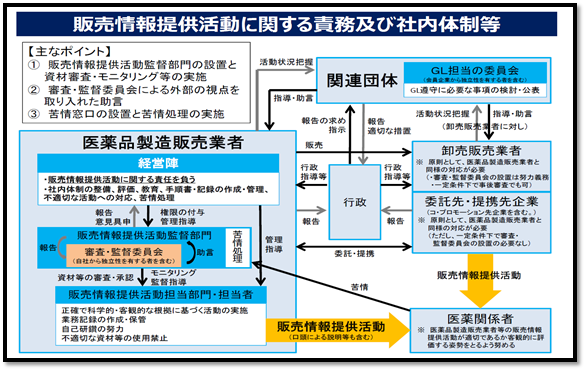
販売情報提供活動監督部門の役割
(1)モニタリング
販売情報提供活動監督部門は,MR・MSL等の販売情報提供活動について定期的にモニタリング等の監督指導を実施する必要がある。メディカルアフェアーズ部門は被監督部門となる可能性があるため,販売情報提供活動監督部門とすることは原則として認められない。なお,販売情報提供活動監督部門内において,審査,モニタリング等についてそれぞれ責任者を置くことは差し支えないが,販売情報提供活動について,責任の所在を明確にし,一貫した対応を行う必要がある等の観点から,両機能を統括する販売情報提供活動監督部門の責任者は明確化される必要がある。 また,モニタリングに関する業務を行う実務担当者は,販売情報提供活動の担当部門から独立した部門に所属する者とすることが望ましいが,販売情報提供活動監督部門において,より実効的なモニタリングを行うために必要であると判断し,販売情報提供活動の担当者(メディカル部門の人員を含みうる)の経験等を活用することを否定するものではない。ただし,販売情報提供活動の担当者がモニタリングに関する業務を実施するに際しては,モニタリングの手順や評価項目を客観的に定めることや,当該担当者の販売情報提供活動監督部門における人事上の位置づけを明確にすること等により,適正なモニタリングが行われるための体制を構築する必要がある。(2)資材審査
販売情報提供活動の資材等は,使用される前に予め販売情報提供活動監督部門による審査を受ける必要がある。その際,販売情報提供活動監督部門は審査・監督委員会の助言を踏まえて承認を行う。(3)苦情処理
販売情報提供活動の実施について苦情があった場合は,販売情報提供活動監督部門において迅速に事実関係を調査し必要な措置を講じる。(4)報告及び意見具申
販売情報提供活動監督部門は審査・監督委員会に対し,販売情報提供活動の実施状況について定期的に報告を行うとともに,審査・監督委員会は監督部門に対して必要な助言を行う。販売情報提供活動監督部門は経営陣に対して販売情報提供活動の実施状況を報告するとともに,必要がある場合には,審査・監督委員会の助言を踏まえて経営陣に意見具申をする。審査・監督委員会
審査・監督委員会には,医薬品製造販売業者等の利害にとらわれることなく,販売情報提供活動監督部門に対する助言を行うことにより,販売情報提供活動の資材等の審査やモニタリング等の監督指導が適正に行われることを確保する役割が求められている。「自社からの独立性を有する者」については,医薬品製造販売業者等の利害にとらわれない社外者としての立場から毅然とした助言を行うことができる者といえるかどうかを,慎重に判断する必要がある。また,審査・監督委員会による販売情報提供活動監督部門に対する助言が適正に行われることを確保する観点から,販売情報提供活動の資材等の審査の業務を行う者が,審査・監督委員会の構成員となることは認められない。したがって,現に販売情報提供活動の資材等の審査を行っている外部の弁護士等の専門家を,「自社から独立性を有する者」として活用する場合は,販売情報提供活動監督部門ではなく,審査・監督委員会の構成員として位置づける必要がある。 審査・監督委員会は,販売情報提供活動監督部門外の内外いずれに設けても構わないが,いずれの場合も審査・監督委員会の助言を十分活用し,モニタリングや審査等に第三者の視点が適切に反映されるような体制を構築することが重要となる。 また,販売情報提供活動監督部門の責任者に対して必要な助言ができる適切な外部機関に審査・監督委員会の業務を委託してもよいが,その場合であっても,モニタリングや審査等の監督指導に関する責任は販売情報提供活動監督部門が担う必要がある。その他
評価・教育
経営陣は,役員・従業員が適切な販売情報提供活動を行ったかどうか及び行わせたかどうかを確認し,役員・従業員に対する評価に適切に反映する。例えば,販売情報提供活動の担当部門に所属する者に対して,適切な販売情報提供活動を行ったこと及び行わせたことを人事上の評価項目として設定するなど,売り上げ至上主義によらない人事評価制度や報酬体系とすることが考えられる。手順書の作成
経営陣は,販売情報提供活動の担当部門・担当者に,販売情報提供活動に係る業務を適切に行うために必要な手順書を作成させる。また,厚生労働省,関係自治体やPMDAから販売情報提供活動に関係する資料の提出を求められた場合には,販売情報提供活動の資材等に加えて手順書を提出すること等により,活動状況を速やかに報告する。 販売情報提供活動の方法,業務記録の作成,販売情報提供活動の資材等の取扱い等の項目を含め,当ガイドラインを遵守した適切な販売情報提供活動が行われることを担保することができるよう,各社の販売情報提供活動等の状況に応じて,手順書を定め,また,手順書の項目については,各社における運用を踏まえ,随時必要な改訂を行う必要がある。記録作成・保管
経営陣は,業務記録(販売情報提供活動において口頭で説明等を行った内容の記録を含む。)を作成させ,当該業務記録を適切に保管させる。また,厚生労働省,関係自治体やPMDA から販売情報提供活動に関係する資料の提出を求められた場合には,販売情報提供活動の資材等に加えて業務記録を提出すること等により,活動状況を速やかに報告する。 業務記録においては,販売情報提供活動監督部門による審査済みの販売情報提供活動の資材に基づき,その範囲内での説明を行う限りにおいては,日時,訪問先医療機関名,医師・薬剤師名,使用した資材等の情報を記載することで差し支えないが,販売情報提供活動の資材に記載のない事項についての説明を行う場合は,医師・薬剤師とのやりとりの概要を含めた具体的な内容の記録が求められる。苦情処理
経営陣は,販売情報提供活動について苦情を受け付ける外部から認識可能な窓口を設けるとともに,苦情があったときは,販売情報提供活動監督部門において迅速に事実関係を調査し,必要な措置を講じさせる必要がある。なお,販売情報提供活動について苦情を受け付ける窓口の外部への周知方法は,各社の状況に応じて適切と考えられる方法で周知することで差し支えない。未承認・適応外情報の提供
未承認薬・適応外薬及び国内では認められていない用法・用量に関する情報提供について医療関係者又は医療関係者以外の国民,患者やその団体から求めがあった場合には,次に掲げる条件を全て満たす場合には認められる。- 通常の販売情報提供活動とは切り分けること。
- 情報提供する内容は,要求内容に沿ったものに限定するとともに,情報提供先は要求者に限定すること。
- 医療関係者・患者等から情報提供を求められていないにもかかわらず,求められたかのように装わないこと。
- 提供する情報は,虚偽・誇大な内容であってはならず,科学的・客観的根拠に基づき正確なものでなければならないこと。また,情報提供にあたっては,要約,省略, 強調等を行わないこと。
- 医薬品製造販売業者等による関与があった試験研究の結果やそれに基づく論文等を提供する場合にあっては,当該試験研究が「医薬品の臨床試験の実施の基準に関する省令」(平成9年厚生省令第28 号)若しくは「臨床研究法」(平成29 年法律第16 号)又はこれらに相当するものにより適切に管理されたものであること。
- 副作用の危険性が高まることや,臨床試験において有意差を証明できなかったこと等,ネガティブな情報についても適切に提供すること。
- 情報提供する医療用医薬品の効能・効果,用法・用量等が承認を受けていないことを明確に伝えること。
- 経緯,提供先,提供内容等,情報提供に関する記録を作成し,保管すること。
治験・臨床研究情報の現行参照先(2026年10月11日確認)
令和8年3月30日付「治験等に係る情報提供の取扱いについて」(医薬監麻発0330第1号)は,令和5年1月24日通知を廃止し,治験等の参加者募集と,募集以外の情報提供を分けて条件を示している。参加者募集では,対象となる治験等のjRCTへの登録,募集に必要な内容・期間の限定,未承認等に関する注意事項の表示など,通知所定の条件をすべて満たす必要がある。募集以外の情報提供は患者等に向けたものを対象とし,医療関係者向けの販売情報提供活動にはこの取扱いを適用できない。医薬品名を含む情報は,公開データベースの登録情報・結果概要等を基に,専用のトップページを経由する構成などの条件を確認する。 出典:厚生労働省の2026年3月30日通知,関連Q&A。以下のデータベース案内は現在の参照先の整理である。 国内の治験・臨床研究情報は、厚生労働省の「治験等の情報について」で案内されるjRCT(臨床研究等提出・公開システム)、臨床研究情報ポータルサイト、UMIN-CTRで確認できる。 主たる治験及び人道的見地から実施される治験(拡大治験)の情報は、PMDAの公表ページを参照する。海外を含む臨床研究情報の参照先としては、ClinicalTrials.govもある。OVERVIEW OF GUIDELINES ON SALES INFORMATION PROVISION ACTIVITIES
Checked and supplemented: October 11, 2026.
Scope: the supplemental Q&A of February 21, 2024 (Part 4), the editions and effective dates of the research ethics guidelines, and current clinical trial information sources. The underlying sales information guidelines were issued on September 25, 2018; subsequent clarifications are identified separately.
The explanations of Medical Affairs, material reviewers, records and complaint channels refer to MHLW’s February 20, 2019 Q&A No. 1, Q21, Q25 and Q31–34 (Japanese), and supplement the Guidelines.
OVERVIEW OF GUIDELINES ON SALES INFORMATION PROVISION ACTIVITIES
The activities of pharmaceutical companies in modern era has become increasingly complex and diverse, and there are increasing numbers of cases where it is difficult to determine whether they meet the above three requirements of advertisement, such as medical information provided by the so-called Medical Science Liaison (MSL), media seminars held as a function of corporate public relations, press releases for investors, and disease awareness raising for patients. Against this background, the Sales Information Provision Activities Guidelines (the “Guidelines”) took effect on April 1, 2019. Section II and matters relating to the sales information supervisory department took effect on October 1, 2019 (Section IV.8).1. Applicable body
The Guidelines apply to marketing authorization holder of pharmaceuticals and their entrustees and partners (including so-called co-promotion partners) and pharmaceutical wholesalers (collectively referred to as the "marketing authorization holder of pharmaceuticals"). All employees of the marketing authorization holder of pharmaceuticals shall be subject to the Guidelines irrespective of the names or departments such as Medical Representative (MRs, as stipulated in Article 2, Paragraph 5, of the GVP Ministerial Ordinance), Medical Science Liaison (MSL). Even if the company's internal rules stipulate that the activities of the Medical Affairs Department and MSL be clearly separated from sales information provision activities, the applicability of the Guidelines is assessed and judged on a case-by-case basis according to the actual activities conducted, and such internal rules do not automatically exclude the applicability of the Guidelines. Also, if a lecture by an external expert (healthcare professional, etc.) at an event sponsored by the marketing authorization holder of pharmaceuticals meets the requirements of "sales information provision activities" considering the objective and purpose of the event, such lecture will be subject to the Guidelines.2. Covered Activities
Guidelines define sales information provision activities as "provision or conveyance of information by the pharmaceuticals marketing authorization holder, etc. of information relevant to a particular ethical pharmaceuticals in anticipation of sales promotion thereof through improvement of recognition of the name or effectiveness or safety of the relevant ethical pharmaceuticals, irrespective of whether such activities are active or passive, and includes raising awareness of diseases relating to efficacy or the effects of the ethical pharmaceuticals (including that which targets the general public)." The Guidelines are designed to improve the current status of advertisement or advertisement-similar activities that are difficult to determine applicability of advertisement-related regulations, such as conducts that are not clearly false or exaggerated but are considered to encourage inappropriate use or misuse. Therefore, it should be noted that "in anticipation of sales promotion" has wider meaning than the “induction” in the three requirements of advertisement ("clearly intended to induce consumers to purchase products"). Even disease awareness-raising activities conducted can be within the scope of the Guidelines.3. Principles and Prohibitions of Information Provision Activities
The Guidelines include the following four principles of sales information provision activities:- Efficacy, effect, dosage or administration, etc., of the ethical pharmaceuticals to be provided is within the approved scope.
- Necessary information shall be provided and information to be provided shall not be selected arbitrarily, such as provision of information on safety that includes side effect, not just the effectiveness of the ethical pharmaceuticals.
- Information provided must be accurate and based on scientific and objective grounds, and the grounds can be presented. Scientific grounds must be grounds for which objective evaluation and verification by a third party is possible, including the original data thereof, or which have undergone assessment of appropriateness (referee reading of paper, etc.) by a third party (including evaluation materials or assessment reports used for assessment for approval).
- Information cited in sales information provision activities materials must have the original citation source clearly stated. In addition, for external research and studies, if there has been any provision of items, moneys or labor, etc. by the pharmaceuticals marketing authorization holder in relation to implementation of examination on sources of citations, studies or preparation of papers, etc., the specific details thereof must be clearly stated. In addition, for external research and studies, only those that observe the “Clinical Research Act” (Act No. 16 of 2017), “Ethical Guidelines for Medical and Health Research Involving Human Subjects” (Announcement No. 3 of MEXT and MHLW of 2014), and other similar guidelines may be used.
Supplement: research ethics guidelines
The 2014 research ethics guideline title above reflects the wording of the 2018 sales information notice. In 2021, those guidelines were combined with the genome research guidelines in the new 人を対象とする生命科学・医学系研究に関する倫理指針. As of October 11, 2026, consult the version amended on March 27, 2023, together with the related guidance and applicable transitional provisions.
The amendment issued on August 27, 2026 has been published, but takes effect on December 1, 2026. Currently applicable 2023 version / 2026 amendment and commencement notice / Guidelines and related guidance index (Japanese)
In addition, the following seven terms are referred to as "prohibited activities."- Use of false or extravagant wording or language that induces misperceptions, or conduct of other acts prohibited in advertising regulations
- Recommendation of methods of use other than the approved efficacy, effect, dosage or administration, etc. This shall be the same even in the case where approval, etc. is obtained in foreign countries.
- Inducement to prescription or use, etc. specific ethical pharmaceuticals arbitrarily, without scientific or objective grounds
- Promotion of own products by slandering or defaming products of other companies
- Excessive emphasis on morbidity or symptoms of disease, and arousing anxiety
- Recommendation of treatment alone (including diagnosis and prevention; the same shall apply hereinafter) with ethical pharmaceuticals in awareness raising of disease in the general public, or creating the misperception that there is no method of treatment other than treatment with ethical pharmaceuticals
- Use of other language that may induce improper use or misuse of ethical pharmaceuticals
Supplemental Q&A, Part 4 (February 21, 2024)
MHLW clarified the following points in its supplemental Q&A.
- Other products and comparative information: When responding to a physician or pharmacist, confirm the specific request, limit the information to that request and its recipient, provide accurate information supported by scientific and objective evidence, and explain why direct comparison is scientifically inappropriate where relevant. Do not selectively present only unfavorable information about another product or pretend that information was requested. Comparative information is not categorically prohibited when unsolicited; it must be provided appropriately under the relevant advertising notices and standards (Q1 and Q10).
- Efficacy and safety comparisons: Simple comparisons of trials with different patient backgrounds may be scientifically unfair. Identify sources and the status of primary and secondary endpoints. Present the overall safety profile rather than selected adverse effects alone (Q3 and Q6).
- Conference findings not yet published as papers: In requested comparisons and related responses, the absence of a published paper does not itself prohibit provision. Clearly explain that the material is an unpublished conference presentation and that its evidence is not sufficiently established; comply with the guidelines and advertising standards (Q4, Q8 and Q12).
- Immediate responses about off-label use: Where an appropriate response is ready, answering a physician's or pharmacist's request on the spot is not itself prohibited. Limit provision to the requester and comply with all conditions in Section 4.3 of the guidelines (Q11).
MHLW supplemental Q&A, Part 4 / Original 2018 guidelines (Japanese)
RESPONSIBILITIES OF MANAGEMENT
4. RESPONSIBILITIES OF MANAGEMENT
The Guidelines clearly states that the management of the marketing authorization holder of pharmaceuticals is responsible for its employees’ every operation-related conduct associated with sales information provision activities. The Guidelines also require the management to take leadership in the establishment of the necessary internal systems for implementing appropriate sales information provision activities. The primary contents of the responsibility of the management are as follows.- Management shall establish a division to perform monitoring of appropriateness, etc. of sales information provision activities materials and sales information provision activities themselves (Sales Information Provision Activities Supervisory Division (“Supervisory Division”)) to confirm that the company is conducting sales information provision activities appropriately, clarify the person responsible, and grant authorities to enable supervision and instruction such as necessary monitoring, etc. to Supervisory Division or person in charge of sales information provision activities.
- Management shall establish an Assessment and Supervisory Committee that includes persons who are independent from the company, and have the Committee give necessary advice to the persons responsible for activities in Supervisory Division.
- Supervisory Division shall report on the status of implementation of sales information provision activities to management, and if necessary for proper sales information provision activities, and submit opinions to management based on advice from the Assessment and Supervisory Committee, and management shall take proper measures based on the relevant opinions.
- Management shall properly reflect in evaluations and remunerations for officers and employees, regardless of whether or not the person engaged in or had others engage in proper sales information provision activities. In addition, management shall regularly carry out education for officers and employees so that proper sales information provision activities may be conducted.
- Management shall have Supervisory Division or person in charge of sales information provision activities prepare necessary manuals so that operations relating to sales information provision activities will be performed properly, and also prepare operation records (including records of contents of oral explanations, etc. in sales information provision activities), and have the relevant operation records stored properly. In addition, when MHLW, related local government or PMDA requests submission of related materials, management shall have the activity status reported promptly together with sales information provision activities materials.
- When management becomes aware of the fact that improper sales information provision activities are being conducted at the company, management shall promptly conduct an investigation of the complete facts and take the required measures such as correction or recurrence prevention. In addition, management itself must confirm the status of progress and instruct on taking additional measures if necessary, and for violators, strictly conduct proper evaluation and disposition.
- Management shall establish a contact window that can be recognized by external parties that accept complaints about sales information provision activities, and if there is a complaint, Supervisory Division shall swiftly investigate the complete facts, and have the necessary measures taken.
- Management shall work on companies to whom sales information provision activities are commissioned or affiliated, and pharmaceuticals wholesalers to conduct proper sales information provision activities.
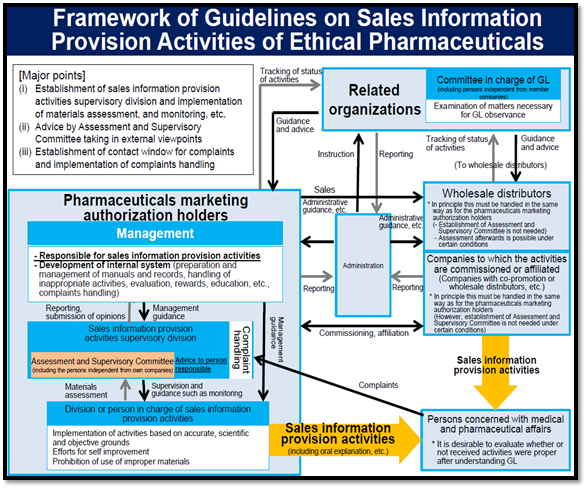
ROLES OF SUPERVISORY DIVISION
(1) Monitoring
Supervisory Division shall periodically conduct supervision and instruction such as monitoring for sales information provision activities by MRs, MSLs, etc. As a general rule, the Medical Affairs Department cannot serve as the sales information supervisory department because its activities may themselves require supervision (Q&A No. 1, Q21). It is possible to appoint a responsible person within Supervisory Division for reviews and monitoring respectively, provided, however, since it is necessary to implement consistent measures under clear responsibility, the responsible person of Supervisory Division who oversees both functions must be clarified. It is also preferred that the person in charge of monitoring belongs to a department independent of sales information provision activities. However, when Supervisory Division considers that persons in charge of sales information provision activities (this could include personnel in medical department) are necessary for implementing more effective monitoring, utilizing the experiences of such persons will not be denied. Even in this case, however, when a person in charge of sales information provision activities carries out monitoring-related activities, it is necessary to establish a system for conducting appropriate monitoring by objectively defining monitoring procedures and evaluation items, and clarifying the status of such persons in Supervisory Division.(2) Review of Materials
Materials for sales information provision activities must be reviewed by Supervisory Division prior to use. In doing so, Supervisory Division shall approve the materials based on advice of Assessment and Supervisory Committee.(3) Handling of Complaints
When there are complaints regarding the implementation of sales information provision activities, Supervisory Division shall promptly investigate the facts and take necessary measures.(4) Report and Provision of Opinions
Supervisory Division shall regularly report to Assessment and Supervisory Committee on the status of sales information provision activities, and the Assessment and Supervisory Committee shall provide necessary advice to Supervisory Division. Supervisory Division shall report the status of sales information provision activities to management and, when necessary, provide opinions to management based on advice of Assessment and Supervisory Committee.ASSESSMENT AND SUPERVISORY COMMITTEE
Assessment and Supervisory Committee is required to take the role of, independent from the interests of the marketing authorization holder of pharmaceuticals, by providing advice to Supervisory Division, ensuring proper implementation of reviews of materials for sales information provision activities and supervision and instruction such as necessary monitoring. “Persons who are independent from the company” must be carefully selected in view of capability to provide resolute advice from the standpoint of outside parties irrespective of the interests of the marketing authorization holder of pharmaceuticals. In addition, from the viewpoint of ensuring proper advice by Assessment and Supervisory Committee given to Supervisory Division, the person who reviews of materials for Supervisory Division shall not be a member of Assessment and Supervisory Committee. Therefore, when the company positions outside lawyers or other experts who are currently reviewing materials for Supervisory Division as “persons who are independent from the company”, they shall be positioned as a member of Assessment and Supervisory Committee, not a member of Supervisory Division. Assessment and Supervisory Committee may be established either inside or outside Supervision Division. In either case, it is important to fully utilize advice of Assessment and Supervisory Committee and to establish a system that appropriately reflects the viewpoint of third parties in the monitoring and review of materials. In addition, Assessment and Supervisory Committee may be entrusted to an appropriate external organization capable of providing necessary advice to the person in charge of Supervisory Division; provided, however, even in this case, Supervisory Division shall assume responsibility for supervision and guidance such as monitoring and reviews.OTHERS
Evaluation and Education
Management shall confirm whether or not officers and employees have implemented appropriate sales information provision activities and shall appropriately reflect the result of such confirmation in their evaluations. For example, evaluation and remuneration system which is detached from “sales supremacism” model should be considered, such as setting conducting or having subordinates conduct appropriate sales information provision activities as an evaluation item for persons belonging to departments in charge of sales information provision activities.Preparation of Manuals
Management shall make the department or persons in charge of the sales information provision activities prepare the manuals necessary for the proper implementation of operations associated with sales information provision activities. Also, when MHLW, relevant municipalities, or PMDA requests the submission of data related to sales information provision activities, the status of the activities shall be promptly reported by submitting manuals in addition to materials for sales information provision activities. To ensure appropriate sales information provision activities in compliance with the Guidelines, it is necessary to establish manuals based on the operations of each company, including items such as methods of sales information activities, preparation of operation records, handling of materials, and to make necessary revisions on the manuals in accordance with the operations.Record Preparation and Retention
Management shall prepare operation records (including a record of the contents of oral explanation, etc. in the sales information provision activities) and have the relevant operation records appropriately retained. In addition, when MHLW, relevant municipalities, or PMDA requests the submission of data related to sales information provision activities, the status of the activities shall be promptly reported by submitting operation records in addition to the materials and other information provided by sales information provision activities. In the operation records, information such as the date and time, the name of the medical institution to be visited, the name of the physician/pharmacist, and the materials to be used may be entered when activities are based on the materials that have been reviewed by Supervisory Division. However, when an explanation is made on the matters not included in the materials, a record of the specific details, including a summary of communication with the physician and pharmacist, is required.Handling of Complaint
Management shall establish a contact window that can be recognized by external parties that accept complaints about sales information provision activities, and in the event of a complaint, Supervisory Department shall promptly investigate the facts and take necessary measures. Companies may inform the outside of the contact window in a manner deemed appropriate depending on the situations of each company.PROVISION OF UNAPPROVED OR OFF-LABEL INFORMATION
When healthcare professionals or members of the public, including patients and their organisations, request information about unapproved pharmaceuticals or off-label use, the information may be provided only if all of the following conditions are satisfied:- Provision shall be separated from ordinary sales information provision activities.
- Contents provided as information shall be limited to the required details, and recipients of the information shall be limited to the requestors.
- Requests must not be falsified to create the appearance that medical personnel or patients requested provision of information.
- Information to be provided shall not have false or extravagant contents, and must be scientific, objective and accurate. In addition, in provision of information, summarization, omission or emphasis, etc. shall not be performed.
- When providing a paper, etc. based on testing and research involving pharmaceuticals marketing authorization holders, the relevant testing and research must be properly managed in accordance with the Ministry Order on Standards for Implementation of Clinical Testing of Pharmaceuticals (MHLW Order No. 28 of 1997) or “Clinical Research Act” (Act No. 16 of 2017) or similar laws and regulations.
- Disadvantageous information such as increasing risks of side effects or inability to certify significant differences in clinical testing, etc. shall also be provided properly.
- Clearly convey the fact that the efficacy and effect, dosage and administration, etc. are not approved for the ethical pharmaceutical for which the information is being provided.
- Records must be prepared and stored relevant to information provision such as on the background, recipient of information, or details of provision.